Ball Blast Cannon blitz mania
- 4.2
- Rating
- 50.00M
- Installs
- Free
- Price

 Analysis by App-foxy
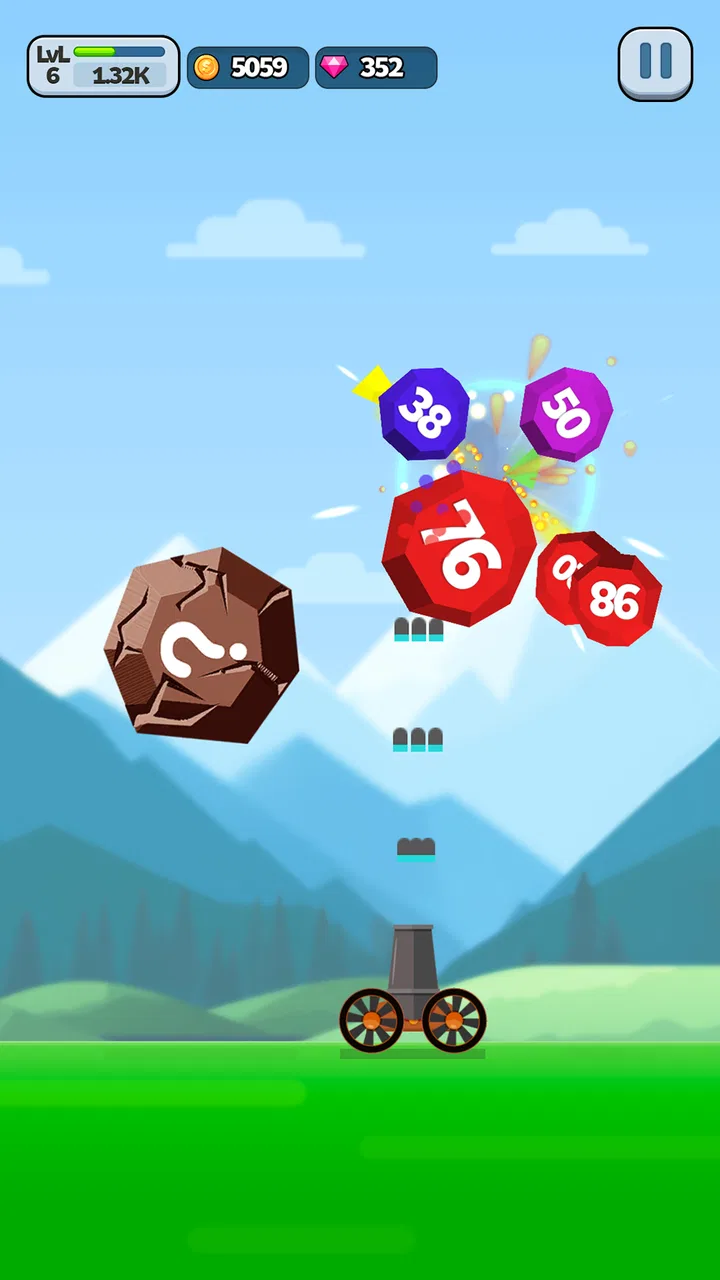
I spent time with Ball Blast Cannon blitz mania as a quick-fire arcade game, paying particular attention to how comfortably it works in different situations rather than judging it only by its score-chasing appeal. The basic idea is easy to understand: I control a cannon, fire upward at descending numbered balls, collect what the playfield offers, and improve the cannon while trying to stay alive. That simplicity is the reason it is so easy to start, but it also means the game depends heavily on timing, visual attention, and repeated swiping.
Created by VOODOO, this free game sits in the arcade category and is suitable for Everyone. It has reached over 50 million installs, with an average rating of 4.2 from around 591 thousand ratings and roughly 28 thousand written reviews. Those figures suggest that its short-session format has found a large audience, but they do not change my main conclusion: this is best understood as a focused reflex game, not a broad, relaxing entertainment app.
How Ball Blast feels to read and navigate
I’ll focus on how the game’s straightforward cannon control shapes the experience: it makes the action easy to enter, while putting most of the challenge on reading the screen and moving accurately. That distinction matters when deciding whether it suits a quick break or a longer session. Next, I’ll look at what those demands can mean in different playing situations.
You May Also Like

 Blood Strike: 2.5 Anniversary
Blood Strike’s Loadouts Turn Every Drop Into a Tactical Gamble
A close look at Blood Strike’s custom loadouts: how fast access to signature weapons reshapes its battle royale rhythm, rewards preparation, and narrows the gap between fights.

 Pandora - Music & Podcasts
Pandora’s Music Is Easy to Start, but Harder to Recover
Pandora’s strength is its low-effort path from a seed to a station. Its weak spot is how much confidence it asks you to place in connection, setup, and quiet recovery.

 8 Ball Pool
 Is Built on Rivalries, Rematches, and Routine
A close look at the rivalries, rematches, shared routines, and unanswered safety questions that turn a quick pool match into a persistent mobile community.

 Samsung Music
’s Quiet Strength Is Playing What You Already Own
Its reach comes less from spectacle than from dependable access to a personal library. That simplicity is both the app’s strongest retention engine and its ceiling.

 AccuWeather: Weather Radar
AccuWeather Review: A Quick, Clear Forecast for Everyday Decisions
For everyday plans, the best forecast is the one you can understand quickly. AccuWeather makes rain timing, radar, and local conditions easy to act on, with a few trade-offs.

 Hill Climb Racing
Why Hill Climb Racing Still Turns Crashes Into One More Run
A tiny car, a bumpy hill and one more upgrade: Hill Climb Racing keeps resurfacing because its simple chaos makes every near-miss feel personal.
More From Our News Desk



A clear first step for new players
The strongest accessibility quality is the immediate clarity of the playfield. The cannon is placed at the bottom, the targets move toward it, and the action is visually centered. I did not need a long explanation to understand what I was supposed to do. That matters for anyone who prefers learning by watching rather than reading instructions, and it also makes the game approachable for younger players who meet the Everyone age rating.
The interaction is equally direct. Instead of combining several buttons, menus, or complicated commands, I mainly focus on moving the cannon and keeping the shots going. In a noisy daily routine, that low command count is useful: I can open the game, recognize the situation quickly, and begin without remembering a control scheme.
Visual hierarchy helps, but the screen can become busy
At the beginning of a run, the important elements are easy to separate. The balls are the danger and the cannon is the tool I need to position. As more objects move and numbers change, however, my attention has to divide between aiming, watching the lower edge, and judging which targets need continued fire. The game communicates through motion and contrast more than through detailed text, which is efficient but not equally comfortable for every player.
I found it helpful to keep my eyes near the space immediately above the cannon instead of staring at one target for too long. This creates a wider visual watch area and gives more time to react. It is a small habit, but it makes the display feel less frantic than trying to track every ball separately.
Menus are less important than the live action
Because the core loop is so compact, most of the real usability question is not whether I can find a setting; it is whether I can understand the action while it is happening. The game does not ask me to navigate a large role-playing interface or manage a complicated inventory. That is a benefit for players who find dense menus tiring, but it also leaves little room to adapt the experience around individual needs.
The upgrade focus gives each attempt a recognizable purpose. I am not merely surviving for a few seconds; I am also trying to make the cannon more capable. That progression is easy to grasp, although the repeated upgrade cycle can encourage me to continue playing longer than planned. For short breaks, I recommend deciding in advance how many attempts to play rather than relying on the game to provide a natural stopping point.
Useful reading habits for the battlefield
The numbers on the balls are not just decoration. They tell me that some targets need more attention than others, so I learned to avoid wasting every shot on the nearest object when a more dangerous ball is approaching. Watching movement first and numbers second is usually more manageable than trying to process both with equal intensity.
Another practical adjustment is to use a steady, controlled finger movement instead of sweeping rapidly from one side to the other. Broad swipes may feel fast, but they can make the cannon overshoot the target and create extra visual confusion. Smaller movements give me better control and reduce the need to correct mistakes immediately.
Motor, sensory, and situational considerations
The simple input may feel approachable, but comfort depends on more than how many controls a game uses. I’d consider whether repeated swipes and moving targets fit the player’s hands, vision, and surroundings, especially when play happens in short gaps between other tasks. With those practical needs in mind, the next section compares its focused loop with other arcade styles.
Why the control style is approachable
The cannon-based design keeps the physical input simple. I do not need to coordinate several on-screen buttons while also reading a map or selecting abilities. That makes the game a reasonable choice for someone who enjoys arcade play but dislikes complex control layouts. A player using one hand can understand the basic interaction quickly, and the portrait-style focus keeps the main action close to the area where the hand is already working.
Still, simple does not mean effortless. The game asks for repeated touch input, quick directional changes, and sustained attention. Someone with limited finger movement, hand fatigue, tremors, or difficulty making accurate swipes may find the same simplicity restrictive because there is not much else to fall back on. The game’s challenge is tied directly to control precision.
Repeated motion can become the real difficulty
My main physical concern is repetition. A short session may feel light, but several runs in a row can turn the same swipe into a tiring movement, especially when I try to compensate for mistakes with faster gestures. I get better results by keeping my hand relaxed and taking pauses between attempts. That is not merely a comfort tip; it also improves accuracy because tense movements make the cannon harder to place.
Players who need a slower pace should know that this is not a turn-based arcade experience. The balls continue to create pressure while I decide what to do. If I need generous reaction time, frequent pauses during the action, or a control method that does not depend on touch precision, this may not be the right game for me.
Motion and contrast demand visual attention
The game relies on moving objects, changing positions, and quick visual judgments. That can be enjoyable for players who like a lively screen, but it may be uncomfortable for people sensitive to constant motion or who become overwhelmed when several objects compete for attention. I found that playing with the phone held at a comfortable distance and avoiding a very bright environment made it easier to concentrate.
Players with color-vision differences may also need to judge objects by their shape, position, movement, and numbers rather than color alone. I would not treat color as the only useful clue. The numbers provide an additional layer of information, but the player still has to see them clearly while the targets are moving.
Sound is not the heart of the experience
This is a visually led game. My decisions come from where the cannon and balls are, how quickly targets approach, and which numbers remain. That makes it more practical than an audio-dependent game for playing in a shared space, such as a waiting room or a quiet break at work. I can understand the central challenge by watching the screen rather than depending on spoken instructions.
At the same time, visual dependence is a genuine limitation for players who cannot comfortably follow moving objects. The game does not become fully accessible simply because its rules are easy to see. Anyone who needs strong nonvisual feedback or an alternative input method should consider a different arcade title designed around those needs.
A realistic everyday use case
I think the best everyday scenario is a short wait: sitting before an appointment, taking a brief transit break, or having a few minutes between tasks. One run gives me a clear activity without requiring a large commitment to story or strategy. The problem is that the upgrade loop makes “one more attempt” tempting, so I would avoid opening it when I need to remain mentally fresh for an immediate task.
It also works well for someone who wants a simple game to share informally with a child. The objective is understandable, the age rating is Everyone, and there is no complicated fictional world to explain before play begins. I would still supervise younger players around optional purchases and set a time limit, because the free entry point does not automatically make every part of the experience cost-free.
Free to start, with a purchase decision to consider
The game is free to download and play, while optional in-app purchases range from $0.49 to $109.99 per item. That is an important practical detail for families and for anyone who prefers games without spending pressure. I recommend treating upgrades as part of the game’s temptation rather than assuming they are necessary. Before handing the phone to a child, I would check the device’s purchase protections and agree on whether spending is allowed.
For me, the best way to enjoy the free version is to judge each run by improvement in control rather than by how quickly I can accelerate progress. That keeps the focus on the arcade challenge. Players who dislike any purchase prompts or progression tied to optional spending may be happier with a paid arcade game that removes that concern from the beginning.
Where it fits among arcade alternatives
I find the clearest comparison is not about which game is universally better, but about what a player wants from a few spare minutes. Ball Blast favors continuous attention and small improvements in positioning, while a puzzle or turn-based arcade game offers more time to pause and think. That difference helps identify who is most likely to enjoy this particular rhythm.
More immediate than a traditional score attack
Compared with a classic arcade game built around a fixed score and a single repeating challenge, this one adds a sense of development through cannon upgrades. That gives unsuccessful attempts a little more meaning because I can return with a stronger setup. The trade-off is that the experience feels less like a pure test of equal conditions and more like a mixture of reflexes and progression.
Compared with puzzle arcade games, it asks less from long-term planning and more from continuous reaction. I do not spend much time arranging a board or solving a sequence before acting. This makes it easier to pick up during a short break, but it offers less satisfaction to someone who wants quiet thought, deliberate problem solving, or a story-driven reason to continue.
Better for quick repetition than for deep variety
The central loop is strong when I want repetition with small improvements. I can focus on positioning, target priority, and survival without learning a large ruleset. However, players who need many distinct modes, extensive customization, or a slower strategic arc may find the experience narrow. Its appeal comes from polishing one action rather than constantly discovering new systems.
That narrowness is also why I would not recommend it as the only game on a long journey. For a few minutes, its directness is a strength. Over a longer session, the repeated motion, similar visual demands, and pressure to keep reacting can become tiring. A turn-based puzzle game or a slower management game would be a better companion when I want variety and recovery time.
Who should approach it carefully
I would be cautious about recommending it to players who are sensitive to fast movement, need frequent pauses during active play, or cannot comfortably perform repeated swipes. The game does not appear to be built around adjustable pacing as its main feature; its identity comes from pressure. It is also not ideal for someone looking for a completely distraction-free free game, because optional purchases can matter to the overall phone experience.
On the other hand, I would recommend trying it to players who like short arcade sessions, visible progress, and a control system that can be understood almost immediately. It is particularly suitable for people who enjoy improving through small changes in timing rather than studying a large set of instructions.
Remaining barriers and practical ways to reduce them
If the fast movement or repeated touch control becomes uncomfortable, I’d treat that as a meaningful mismatch rather than something to push through. Shorter play blocks, a steady phone position, and deliberate movements may help some players, but they cannot change the game’s basic demands. The final consideration is whether those limits are manageable for the person and setting where it will be played.
The game asks for precision without much forgiveness
The most important barrier is the connection between a player’s physical control and survival. If the finger moves too far, too slowly, or at the wrong moment, the result is immediately visible. That can feel satisfying when I improve, but discouraging when a physical limitation makes accuracy inconsistent. I would not describe the game as broadly adaptable; I would describe it as straightforward but demanding.
A useful approach is to play in shorter blocks and stop when hand tension begins. I also found that keeping the phone stable, rather than shifting it between hands during a run, helps reduce accidental movement. These habits cannot replace accessible control options, but they can make ordinary play less tiring.
Attention management matters as much as reflexes
People often describe this kind of arcade game as a test of speed, but I found that attention management is just as important. Looking everywhere at once leads to rushed decisions. I do better by scanning the whole lower half of the playfield, identifying the most urgent target, and then returning to a central position. This is a concrete strategy that makes the game feel more readable without changing any settings.
It is also worth playing in a setting where interruptions are unlikely. A notification, conversation, or sudden movement nearby can break concentration at exactly the wrong moment. For a player with attention difficulties, the game may be more comfortable in a quiet, predictable setting, while another arcade title with pauses or turn-based actions may provide fairer access.
Progress can influence spending expectations
The upgrade structure is motivating, but it can create a subtle trade-off. When I have just failed, improving the cannon sounds like the obvious answer, even though better timing may be the more useful improvement. I recommend trying a few deliberate runs before considering any purchase. If the game is no longer enjoyable without faster progress, that is a sign that the purchase pressure is affecting the experience rather than improving it.
Because the highest listed purchase reaches $109.99, I would be especially careful on shared devices. A free game can still require a clear household rule about spending. Players who want a simple arcade challenge with no concern about optional transactions may prefer a different model, even if that alternative costs money upfront.
Version and device expectations
The current version is 4.3, and the minimum operating system is Android 8.0. That makes it relevant to many older Android phones, although the actual comfort of play will still depend on the device’s screen, touch response, and general condition. A small or unreliable display can make moving targets harder to follow, while a responsive screen helps the simple controls feel more dependable.
I would check the phone’s available space, touch behavior, and battery condition before judging the game too harshly. If the device already struggles with touch input, a precision arcade game will expose that problem quickly. The game itself may be simple to understand, but the quality of the physical screen remains part of the experience.
My inclusive verdict after playing
Ball Blast Cannon blitz mania is an easy-to-enter arcade game with a clear visual objective, compact sessions, and a satisfying upgrade reason to replay. I like that I can understand the challenge quickly and improve through better positioning rather than memorizing a complicated system. Its broad popularity, free price, Everyone rating, and large install base make it an easy title to try, especially for casual players who want action without a tutorial-heavy beginning.
Its inclusive side is strongest in clarity and simplicity, not in flexibility. The game reduces the number of controls, but it does not remove the need for repeated swipes, fast reactions, visual tracking, and sustained concentration. That distinction is important. A player can understand the rules and still find the physical or sensory demands uncomfortable.
My practical recommendation is to try it for short sessions, use controlled movements, watch the playfield as a whole, and treat upgrades as optional rather than essential. It is a good match for quick breaks, casual competition with yourself, and players who enjoy improving a single reflex-based skill. I would skip it in favor of a slower puzzle or turn-based game if I needed adjustable pacing, minimal motion, alternative input methods, or a calmer screen.
Overall, I see it as a focused arcade experience rather than an all-purpose game for every ability and context. When its fast visual style and touch controls fit the player, the simplicity works very well. When those demands create fatigue or make the action difficult to follow, the same simplicity becomes a limitation. That honest trade-off is the key thing to know before installing it.
FAQs for Ball Blast Cannon blitz mania
01What is the main objective of Ball Blast Cannon Blitz Mania?
Ball Blast Cannon Blitz Mania is a fast-paced arcade game where the primary objective is to use a powerful cannon to shoot and destroy falling balls before they reach the ground. As you progress, the balls increase in size and durability, requiring strategic upgrades and precise shots to achieve high scores.
02Are there in-app purchases in Ball Blast Cannon Blitz Mania?
Yes, Ball Blast Cannon Blitz Mania offers in-app purchases. Players can buy coins and power-ups to enhance their gameplay experience. While the game is free to download, certain features and upgrades can be accessed more quickly through these optional purchases, allowing for faster progression.
03Is an internet connection required to play Ball Blast Cannon Blitz Mania?
Ball Blast Cannon Blitz Mania can be played offline, making it convenient for users without a stable internet connection. However, some features like leaderboards and special events may require an internet connection to fully enjoy all the game’s functionalities and compete with friends or global players.
04How does the progression system work in Ball Blast Cannon Blitz Mania?
The progression in Ball Blast Cannon Blitz Mania is based on levels and upgrades. As players destroy balls, they earn coins that can be used to upgrade their cannon's power and speed. Advancing through levels increases difficulty, introducing larger and more resilient balls, requiring strategic enhancements to succeed.
05What age group is Ball Blast Cannon Blitz Mania suitable for?
Ball Blast Cannon Blitz Mania is suitable for players of all ages, but it is particularly engaging for those aged 8 and above due to its simple yet challenging gameplay mechanics. The colorful graphics and straightforward controls make it accessible for younger players, while the increasing difficulty provides a challenge for older ones.
Pros
- Intuitive controls make gameplay easy.
- Bright
- colorful graphics enhance fun.
- Challenging levels keep players engaged.
- Minimal ads allow for smooth play.
- Quick loading times improve experience.
Cons
- Repetitive gameplay can get monotonous.
- Limited power-ups may frustrate players.
- Requires internet for full features.
- Occasional lag in older devices.
- In-app purchases can be pricey.

Ball Blast Cannon blitz mania
Gallery